
Portland Metro service

American Standard Furnace Repair in Portland Metro

American Standard furnace diagnosis depends on the installed Platinum, Gold, Silver or S-series model and whether its controls communicate.

Need help soon? Call now for current availability, or send the service request below.

Verified reviews

Trusted by thousands of Portland Metro homeowners

See our current Google, Yelp and Thumbtack profile ratings and review totals, then request service from our Portland Metro team.

24/7 requests

Request Service

Send your name and phone number. We will call back to confirm what you need, the service address or ZIP code, and current availability in your area.

Get a Call Back

Identify the American Standard series and control type

American Standard furnace repair should begin with the complete model and serial number, not only the brand badge. The manufacturer’s current lineup distinguishes Platinum, Gold and Silver gas furnaces, including S-series equipment with model-dependent variable-speed, two-stage and single-stage configurations. Those differences change how a heating-stage complaint, blower complaint or control alert should be tested.

Record the furnace rating plate and the wall control. Selected Platinum models can use AccuLink or American Standard Link communication, while other furnaces use a conventional thermostat and integrated control. The diagnostic path must first establish which control relationship is actually installed.

Why series names cannot replace the full model number

Platinum, Gold, Silver and S-series names help organize American Standard equipment, but they do not identify every control, stage or blower detail. Furnaces within a broad family can differ by production generation and configuration. The technician needs the complete rating-plate information to select the correct documentation and understand what the thermostat or communicating control should request.

A homeowner can help by recording the full model, serial, thermostat screen and any furnace-board indication that is safely visible. Do not use a partial cabinet label or an outdoor-unit model as the furnace identity. Accurate identification prevents a Link-capable system from being treated as conventional—or a conventional furnace from being diagnosed as a networked system.

Separate Link or AccuLink evidence from the heat sequence

A communicating-control message can be useful because it preserves network or operating information, but it is not proof that the furnace itself has failed. Save the exact alert, time and operating condition. Note whether the furnace ignored the heat request, remained in a lower stage, lost communication or continued to move air without producing stable heat.

The technician then separates the communication path from the physical heating sequence. That may involve checking control configuration, low-voltage wiring and board communication before moving to inducer, pressure, ignition and flame tests. On a conventional system, the thermostat call and board inputs become the starting boundary.

Find where the heat call stops

A useful no-heat diagnosis identifies the last expected action that occurred. If the thermostat shows a heating demand but the furnace remains idle, the problem is evaluated differently from a system that starts the inducer, attempts ignition and then drops out.

Possible American Standard repair groups include:

  • thermostat, Link or AccuLink communication and low-voltage control wiring;
  • inducer operation, pressure switches, venting and model-dependent condensate conditions;
  • igniter operation, gas-valve command and flame sensing;
  • staged heat that does not advance from the requested level;
  • integrated-control indications that require exact-model documentation;
  • variable-speed or ECM blower response, airflow restrictions and limit trips.

Diagnose staged heat as an operating problem, not just “low output”

Two-stage and variable-speed American Standard furnaces can operate differently from single-stage equipment. A customer may feel that the system stays in low stage, runs longer or changes fan sound. The technician should determine the stage requested, the stage recognized by the board and whether the gas, inducer and blower outputs follow that request.

If the furnace does not advance, the cause could be control logic, configuration, a communicating issue, a staged component or a safety condition. If the furnace advances but rooms remain uncomfortable, airflow, duct resistance, filter condition and system balance may be more important than the heating stage itself.

Check ignition, pressure and airflow in the installed order

The combustion path is tested sequentially: inducer, pressure proof, ignition, gas command, flame proof and blower operation. A pressure or venting shutdown can appear as an ignition failure because ignition never receives permission to proceed. A flame-sensing problem can allow a brief ignition and then stop the cycle.

Airflow and limits are evaluated against the exact model and stage. Uneven variable-speed airflow can involve command, motor response, duct conditions or a limit response. A code or control message is matched to American Standard documentation for the installed model rather than to a general online list.

Prepare control and operating details for the service request

For an American Standard service request, include the complete furnace model, thermostat or communicating-control model, the exact alert if one appears, and a description of the cycle. Useful timing details include whether the furnace stays in low stage, whether ignition starts, whether the blower continues after heat stops and whether the issue affects every heat call or only periods of higher demand.

If the system was recently reconfigured, had a thermostat change or experienced a power interruption, record that history without assuming causation. The technician can compare it with Link or AccuLink communication, low-voltage wiring, staging inputs and the physical heating sequence. This avoids erasing a useful distinction between a network event and a combustion or airflow failure.

Set clear repair and project boundaries

The repair scope should name the tested circuit or component and explain how it produced the reported behavior. Equipment age and the condition of the surrounding system can influence the decision, but they do not replace measured findings. The page remains limited to diagnosis and repair of the installed furnace.

The main furnace repair resource covers non-brand-specific service. Planned cleaning and seasonal checks belong on the furnace maintenance section. If the findings support replacement rather than repair, the separate furnace installation page addresses sizing and project compatibility.

American Standard Furnace Repair FAQ

Are AccuLink and American Standard Link on every furnace?

No. American Standard documents communicating capability on selected models. The installed furnace and control must be identified before Link- or AccuLink-specific testing is used.

What control information helps American Standard diagnosis?

Save the exact control or thermostat model, any alert text, the time of the event and whether the furnace started, stayed in one stage or lost communication.

Why can staged heat stay in low stage?

The control may not be requesting higher heat, the furnace may not recognize the request, or a component or safety condition may prevent the stage change. The requested and delivered stages must be tested separately.

What model-label details are needed?

Provide a complete photo of the furnace rating plate with model and serial number. The exact model determines the control type, staging, blower configuration and documentation used.


24/7 requests

Request Service

Send your name and phone number. We will call back to confirm what you need, the service address or ZIP code, and current availability in your area.

Get a Call Back

LOCAL • LICENSED • TRUSTED

One Local Team for HVAC, Plumbing, Electrical & Appliance Service

When your heating, cooling, plumbing, electrical system, or major appliance needs service, you need a local team that can identify the problem and explain practical options. HVAC & Appliance Repair Guys provides heating and cooling, plumbing, electrical, and appliance repair services for homes and businesses.

For repairs, maintenance, replacements, and installations, we inspect the system or appliance, explain what we find, and review the recommended work and price before work begins. Appointment availability depends on the service, address, site access, parts, permits, and current schedule.

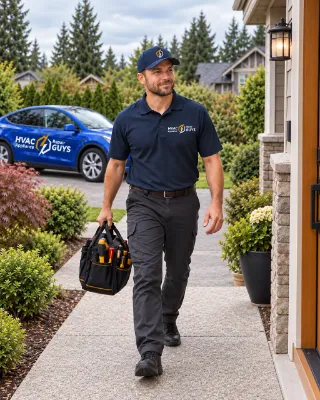
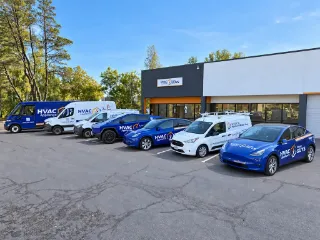
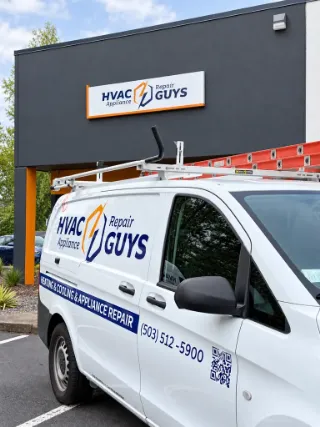
HVAC & Appliance Repair Guys technician at a Portland Metro home HVAC & Appliance Repair Guys service fleet outside the Portland office HVAC & Appliance Repair Guys branded service vehicle
24/7 Calls & Requests Call or request service online anytime. We’ll confirm availability and help schedule the right service.
35,000+ Jobs Completed Repairs, maintenance, and installations completed for homes and businesses.
OR & WA Heating & Cooling · Plumbing · Electrical · Appliance Repair
(503) 512-5900 Request Service