



Air Duct Cleaning in Washougal, WA
HVAC & Appliance Repair Guys provides air duct cleaning in Washougal, WA. Air duct cleaning addresses debris within the agreed heating-and-cooling air path. The condition found should guide the work, whether your concern is a one-time release of particles or a gradual surface buildup.
Tell us what you saw, where it appeared and when it happened. We assess the relevant duct area before recommending work.
A brief event can still provide useful information even if it does not repeat during a visit. Keep its timing and location in the request. Do not run the system again and again just to produce more evidence. The technician can use the original account alongside the current condition and safe access.
Particle Release and Event Timing
Note whether particles appeared as the fan first started or later during ordinary use. Say whether the event happened once or on several separate occasions.
The timing can guide the assessment, but it does not identify the source of the particles.
Include a recent filter change, indoor work or earlier service if relevant. State the order of events and any uncertainty in the dates. A nearby event can provide context without proving a connection.
Keep each witness’s account with the room and time. Reports from different rooms need not describe one event.
Vent Location and Surface Dust
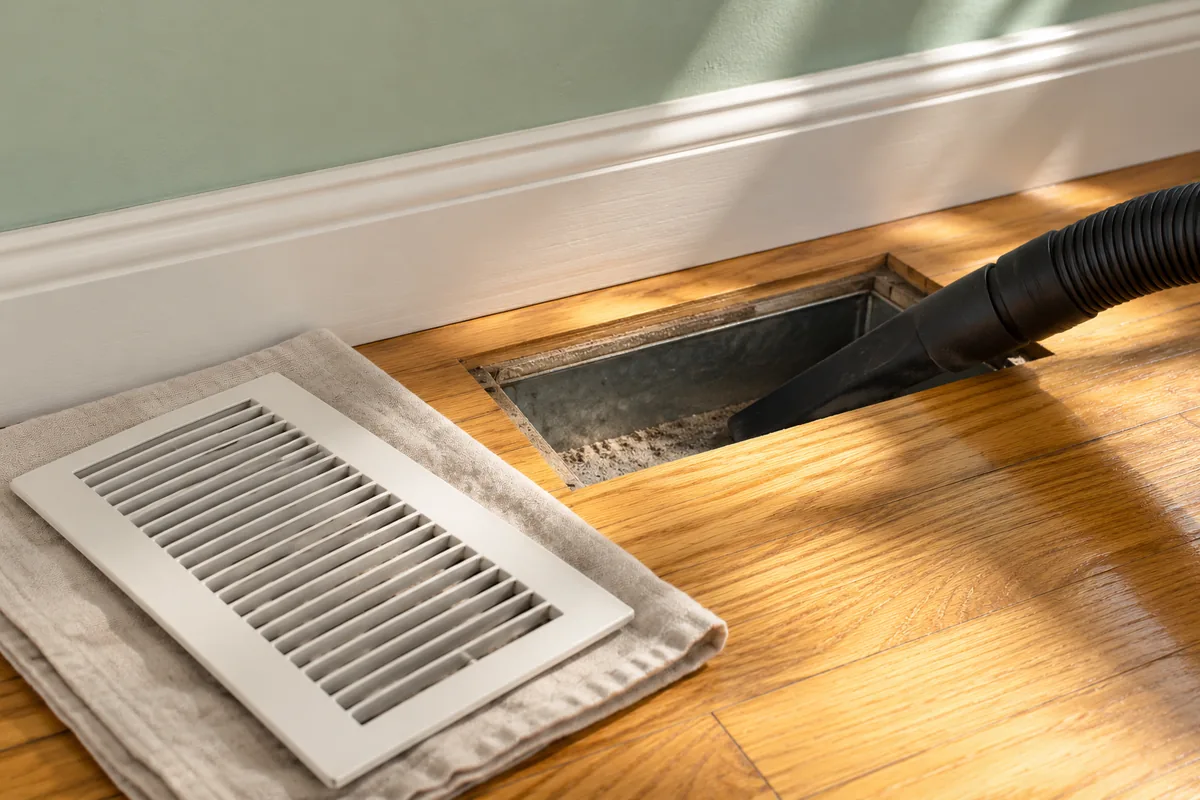
Use a room name and vent position that the site contact will recognize. A close photo can show material while leaving its location unclear. Add a wider view from a safe position if you already have one. Do not remove fixed parts or reach into the duct to gather a more detailed picture.
Distinguish material that appeared to leave the vent from dust already sitting on a nearby surface. That difference matters to the request. A photo taken afterward may not show how the material arrived. Explain what you actually saw so the assessment does not rely on more than the image can establish.
If you are unsure whether the grille supplies air or returns it to the system, say so. The location and observation are still useful. You do not need to trace hidden connections before requesting service. We review the relevant air path before defining the work it may need.
Visible Material and Identification Limits
Describe the visible material in ordinary terms without assigning a substance or health label. Color or shape alone does not identify a substance inside a hidden duct. Keep the safe observation and any existing photo. The service assessment can review what those details actually support.
Do not scrape, disturb or handle material to collect a sample, or spray products inside the duct to see whether the event stops. Share observations and photos you already have. We discuss the appropriate assessment and access before work proceeds.
Cleaning the affected area does not guarantee that every concern in the home will be resolved. If the source remains uncertain, ask what the proposed work addresses and what remains unclear.
Equipment Behavior Between Debris Events
Tell us whether heating, cooling or room airflow changed as well. An equipment stop or new sound is a separate symptom that deserves its own place in the request. Our HVAC repair service in Washougal covers broader fault assessment. Cleaning should not stand in for diagnosing that behavior.
If the system seems to work normally between events, preserve that fact too. Normal use for a period does not erase the earlier report. The record should show both the event and what followed. That helps the technician review an intermittent concern without assuming it has ended or must affect every function.
Share earlier repairs under the equipment and task they concerned; they do not establish the condition of every duct.
Supply and Return Areas and Safe Access
The air duct cleaning overview explains the broader service. For your Washougal request, ask which accessible supply and return areas the proposed job covers. Include any known separate system. A group of visible vents does not by itself establish one complete cleaning route.
Mention high grilles, fixed storage and areas that need separate entry. Do not climb into a tight space or cut an opening before the visit. We discuss access suited to the actual assessment and task. Ask how any unconfirmed section affects the proposed work.
Keep completed areas and open findings. Record the room and timing of any later event so follow-up can assess what changed. Contact HVAC & Appliance Repair Guys to request air duct cleaning in Washougal, WA.
Frequently Asked Questions
Should I make the system produce the particles again before service?
No. Share the events already observed during normal use. Do not disturb grilles or force repeated cycles to recreate the condition. The original account and safe access provide the starting information for assessment.
Can a photo taken after the event prove the source?
It can show what is visible, but it may not show where the material came from. Add the room, timing and what you actually saw. We review the picture as part of the evidence, not a complete diagnosis by itself.
What if the event affects only one room?
Keep that location specific and describe what happened elsewhere only if you observed it. One room’s concern does not establish the condition of every branch. The assessment can define the relevant air path and cleaning scope.
Request Air Duct Cleaning in Washougal, WA
For air duct cleaning in Washougal, WA, call HVAC & Appliance Repair Guys or submit a service request through the form on this page.
Before your visit
Air Duct Cleaning details for Washougal, WA
A useful Washougal, WA duct cleaning request identifies the system, accessible areas, observed debris, and the reason cleaning is being considered. The cleaning work depends on inspection and safe access; an indoor-air-quality or health result is not guaranteed.
Send photos of the equipment
A clear photo of the model and serial label, control display, thermostat or affected area can improve planning for Washougal, WA. Include the equipment type and approximate age when known. Photos help us plan the visit; they do not replace an on-site check.
Confirm permission for the work
For rentals, managed properties, and multi-unit sites in Washougal, WA, confirm who may approve the visit and any recommended work. If building management controls a utility room, roof, mechanical space, shutoff, or common area, arrange that access before the appointment whenever possible.
Share prior service history
Recent maintenance, earlier repairs, replaced parts, renovations, and recurring symptoms help explain the equipment’s service history. Share relevant records and any current concerns for the Washougal, WA visit.
Describe hard-to-reach areas
If the equipment or ductwork is behind a finish, below grade, above a ceiling, inside cabinetry, or in another concealed area, mention it when requesting air duct cleaning in Washougal, WA. Access for service may be separate from drywall, tile, flooring, landscaping, or other finish restoration.